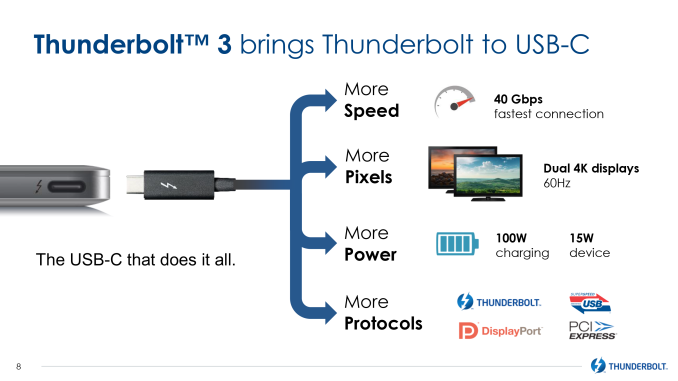
Merging Thunderbolt 3 and USB Type-C brings a huge amount of flexibility and power to the external data bus. Just why and how this is happening technically will be beyond the limits of comprehension for most of us mere mortals, all we have to know is that we now have 40Gbps available for much faster data transfer, more pixels pushed to our 4k displays, more charging power up to 100w and more protocols to connect virtually any dock, device or display.
It looks like we finally have a data bus standard that will provide the flexibility and bandwidth to drive and connect our devices that will expand virtually ‘on demand’.
A lot has been happening in the world of external communication buses over the past year. In the last 12 months the USB consortium has announced both 10Gbps “Superspeed+” USB 3.1 and the new USB Type-C connector, USB’s new compact, reversible connector that is designed to drive the standard for the next decade or more. Meanwhile with the introduction of USB Alternate Mode functionality – the ability for USB Type-C to carry other protocols along with (or instead of) USB Superspeed data – has made USB more flexible than ever, with the VESA announcing that DisplayPort will be supporting alternate mode to deliver DisplayPort video over USB Type-C ports and cabling.
As a result, the introduction of USB Type-C has led to a definite and relatively rapid transition over to the new standard. With the USB consortium having designed a very capable and desirable physical layer for Type-C, and then alternate modes allowing anyone to use that physical layer, there have been a number of other technologies that have started aligning themselves with USB in order to take advantage of what is becoming an even more common platform for external buses.
Check this Topic at anandtech.com
Image courtesy of anandtech.com